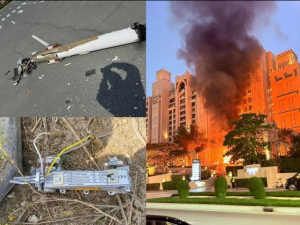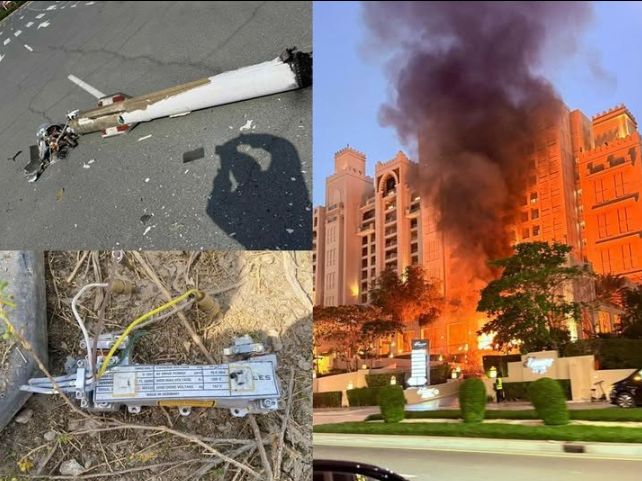
In a shocking escalation of tensions across the Middle East, one of Dubai’s most iconic luxury destinations—Fairmont The Palm—was engulfed in flames following a wave of Iranian missile and drone attacks. The incident, which unfolded amid a rapidly intensifying regional conflict, has sent shockwaves through global markets, governments, and millions of observers who long viewed Dubai as a symbol of safety and stability.
A Sudden Strike in a “Safe Haven”
For decades, Dubai has carefully cultivated its image as a secure, futuristic oasis in a volatile region. Glittering skyscrapers, luxury resorts, and world-class infrastructure made it a magnet for tourists, investors, and expatriates alike. But that image was shattered almost instantly when explosions rocked the skyline late last week.
Witnesses described scenes of chaos as air defense systems lit up the sky, intercepting incoming threats. In the midst of this, one projectile—or possibly debris from an intercepted missile—struck the Fairmont property on Palm Jumeirah, igniting a fire that spread through parts of the luxury complex.
The hotel, a beachfront resort known for its high-end amenities and panoramic views, quickly became the focal point of global headlines. Flames were seen rising from the building, while emergency responders rushed to contain the situation.
Initial reports indicated that at least four people were injured in the incident, though no fatalities were confirmed at the hotel itself. Fire crews managed to bring the blaze under control, preventing what could have been a far more catastrophic outcome.
Importantly, officials later suggested that the damage may not have been caused by a direct hit alone. In several cases across Dubai, falling debris from intercepted missiles and drones caused secondary fires and structural damage—highlighting the unpredictable dangers even when defense systems are effective.
A Wider Wave of Attacks
The strike on the Fairmont was not an isolated incident. It was part of a sweeping Iranian response that targeted multiple countries and locations across the region. Explosions were reported in Bahrain, Jordan, Kuwait, and Qatar, while airports, military installations, and civilian infrastructure were affected.
In Abu Dhabi, debris from interceptions caused casualties, including at least one death and several injuries. Across the UAE, authorities reported dozens of injuries and widespread disruption as hundreds of missiles and drones were intercepted over the course of the attacks.
Airspace closures led to massive travel disruptions, with flights canceled or diverted and passengers stranded. Schools shifted to remote learning, and businesses were advised to allow employees to work from home—an extraordinary move in a country known for its uninterrupted pace of life.
Fear and Uncertainty on the Ground
For residents and visitors, the psychological impact was immediate and profound. Social media filled with videos of explosions in the sky, sirens blaring, and plumes of smoke rising from iconic locations.
One resident described the atmosphere bluntly: “Everyone is very scared… it’s the thing we’ve all feared.”
That fear is rooted not just in the physical danger, but in what the attacks represent. Dubai has long been marketed as a place insulated from the conflicts that affect much of the Middle East. The idea that missiles could reach its shores challenges that assumption in a deeply unsettling way.
The Strategic Context
The attack on Dubai—and specifically the Fairmont—must be understood within the broader context of the unfolding regional conflict. The initial strikes by the U.S. and Israel marked a significant escalation, prompting Iran to respond in a way that demonstrated both reach and capability.
Rather than focusing solely on military targets, Iran’s retaliatory strikes appeared designed to send a message: no location in the region is beyond its range. By targeting high-profile and symbolic sites, the attacks amplified their psychological and political impact.
The inclusion of civilian and economic hubs in the strike zone raises serious concerns about escalation. Analysts warn that such moves blur the line between military and civilian targets, increasing the risk of broader conflict and unintended consequences.
The Role of Air Defenses
Despite the dramatic images, it is important to note that many of the incoming threats were successfully intercepted by UAE air defense systems. Officials emphasized that these systems prevented far greater destruction.
However, the incident also highlights a critical limitation: even successful interceptions can create hazards. Falling debris, shrapnel, and secondary explosions can still cause fires, injuries, and damage—as seen at the Fairmont and other sites.
This underscores a harsh reality of modern warfare: defense systems reduce risk, but they cannot eliminate it entirely.
A Turning Point for Dubai?
Perhaps the most significant impact of the attack is not physical, but reputational. Dubai’s global appeal has been built on the promise of safety, luxury, and stability. The sight of a five-star resort in flames challenges that narrative in a way that may have long-term consequences.
Experts suggest that while the city is likely to recover, the perception of invulnerability has been permanently altered. Investors, tourists, and residents may begin to reassess the risks of living and doing business in the region.
At the same time, the UAE government has moved quickly to reassure the public, emphasizing resilience, preparedness, and the strength of its الدفاع systems.
What Comes Next
As the situation continues to evolve, the world is watching closely. Diplomatic efforts, military responses, and further developments in the conflict will determine whether this incident remains an isolated shock—or becomes part of a larger, more dangerous escalation.
For now, the image of flames rising from the Fairmont stands as a stark symbol of a new reality: in an interconnected and volatile world, even the most seemingly secure places are not immune to the reach of modern conflict.